Google Pay Per Lead vs Google Ads for Contractors
Google Pay Per Lead vs Google Ads for Contractors
Google Pay Per Lead (Local Services Ads) bills you only for valid calls, messages and bookings, after Google checks your license, insurance and background. Google Search Ads bill per click, with no screening. In a February 2026 sample of 888 contractors, SearchLight Digital measured $53 per Pay Per Lead lead against $104 per blended Google Ads lead.
By Ryan Leonard, Owner and Chief SEO at Lemur Marketing. Paid Search Guide · 2026. Updated October 6, 2026.
What Google Pay Per Lead and Google Ads Actually Are
One sells you a customer contact, the other sells you a visit to your website. Everything else follows from that.
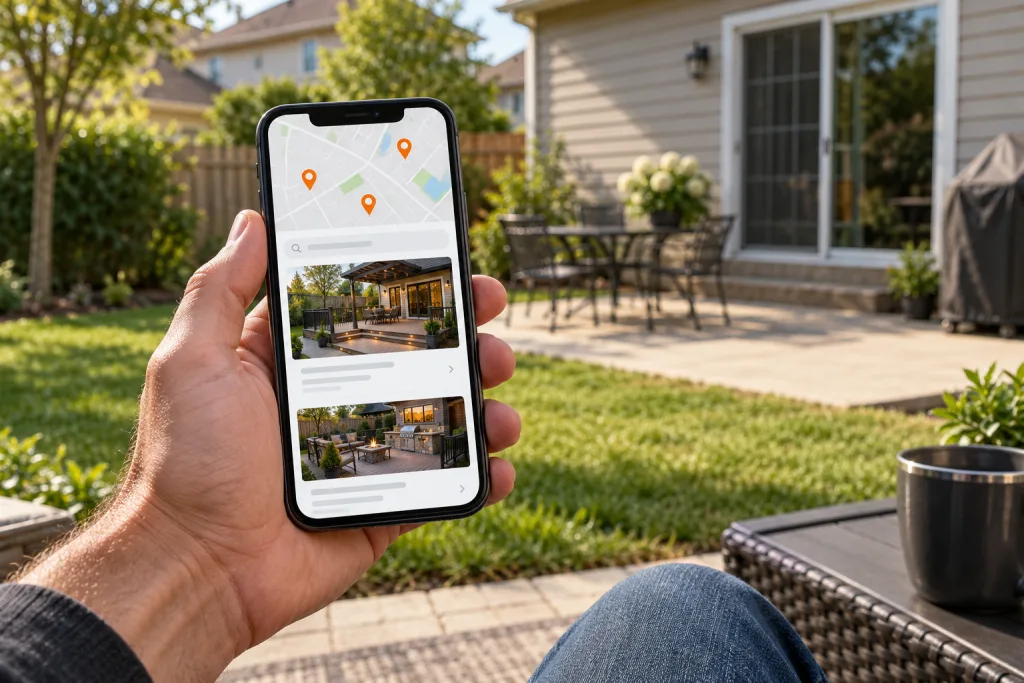
Google Pay Per Lead is Lemur’s name for Google’s Local Services Ads program. Google describes it as a way to “advertise your business on Google and receive leads directly from potential customers,” with leads arriving “as phone calls and messages sent through your Local Services ad” (Google Local Services Help, 2026). The unit shows “prominently in Google Search results” for the services and areas you pick. The searcher sees your business name, rating, review count and a call or message button. There is no website visit in the loop.
Google Ads, in the form a contractor usually buys, means Search campaigns: text ads tied to keywords you choose. Google says these ads “can appear above or below search results on Google Search” and on Google Maps (Google Ads Help, 2026). The ad sends the searcher to your website, and you pay for the click whether or not the visitor calls. With Pay Per Lead, Google absorbs the people who look and do not contact you. With Google Ads, you do, and you earn it back only if your landing page turns clicks into calls.
How Each One Charges You
With Pay Per Lead, “you pay for valid leads”: a phone call you answer, a voicemail or missed call you return, a text or email message, or a booking request (Google Local Services Help, 2026). Message leads are “typically priced lower” than phone leads. You set an average weekly budget, a target rather than a ceiling: weeks vary, but you never pass a monthly max of average weekly budget × 30.4 ÷ 7 (Google Local Services Help, 2026). At the monthly max your ad stops showing until the next month or a budget increase.
The bid is “the most you’d pay for a lead,” and “when similar local businesses bid on the same lead, those bids determine how much the lead is worth” (Google Local Services Help, 2026). As of October 2026 there are three bidding modes: Maximize Leads, where Google sets the bid and recommends a budget of at least 10 leads per week; Target Cost Per Lead, where you name an average; and Max Per Lead, a hard cap. Google says the automated model needs about two weeks to produce accurate results.
Google Ads runs “a lightning-fast ad auction” every time someone searches (Google Ads Help, 2026). Your bid is the maximum you will pay for a click, and Google says you “often” pay less than it, because the auction also scores the quality of your ad and landing page, the expected effect of ad assets such as a phone number, the competitiveness of the auction, and the context of the search. A weak page costs you more for the same position. There is no monthly cap by default; you set a daily budget and the spend follows the clicks.
What a Lead Costs in Practice
SearchLight Digital published the largest Pay Per Lead sample we found with a disclosed method: $6.72 million of Local Services Ads spend across 888 contractors and 126,650 leads from February 1 to 28, 2026, spend-weighted and outlier-filtered, with closed revenue from offline conversion data where it existed (SearchLight Digital, 2026). Blended cost per lead was $53, 43.9% of leads booked, and cost per paying customer was $233 on an average ticket of $1,826. The same agency’s blended Google Ads accounts ran $104 per lead and $472 per paying customer.
By trade, electrical leads cost $39, HVAC $51, plumbing $57 and drain or sewer work $59 (SearchLight Digital, 2026). Read the trade list before the dollar figures. The dataset is repair trades with fast, frequent jobs. No published benchmark we found isolates deck builders, paver contractors, pool builders or remodelers, whose jobs are larger and rarer. Treat $53 as the floor of the range, not the midpoint.
For Google Ads, WordStream by LocaliQ’s 2026 Search Advertising Benchmarks, drawn from thousands of its customers’ campaigns across Google Ads and Microsoft Ads and updated June 1, 2026, put the all-industry average at $5.42 per click and $66.69 per lead (LocaliQ, 2026). Home and Home Improvement ran above both: $8.33 per click and $90.92 per lead, with a 6.47% click-through rate and an 8.05% conversion rate. At that conversion rate about 12 clicks make one lead, which is why the landing page matters as much as the bid.
Lemur’s own remodeling accounts run higher than that repair-trade floor. Across the deck, patio, kitchen and basement contractors we manage, Pay Per Lead leads have averaged about $75, with most falling between $50 and $120 and the outliers ranging from $25 in some suburbs to $180 in others. Those are observed figures from managed accounts, not a published study, so treat them as a working range for budgeting rather than a benchmark.
Who Qualifies and What Google Checks
Pay Per Lead is gated. Google Ads is not. The gate is why the lead unit takes weeks to open.
Local Services Ads are “available only for certain service categories,” and availability varies by location and category (Google Local Services Help, 2026). Google’s screening page lists five requirement types: identity verification, background checks on the business and its owner, business registration, insurance, and licenses. For the General Contractor category in the United States it lists business and owner background checks, general liability and professional liability insurance, and state-level business and owner licenses. Landscaping Services carries the same insurance and license requirements plus a business representative check for some accounts (Google Local Services Help, 2026).
Google says the screening takes an average of 3 to 4 weeks after you submit documents (Google Local Services Help, 2026). Its “Getting started” page also describes an option to receive leads after the preliminary checks while the remaining checks finish. Once you pass, a Google Verified status shows on your ad and your Google Business Profile. Google Ads has no equivalent step. Any business with a payment method and a policy-compliant ad can run Search campaigns at once: a contractor with no license or insurance on file can outbid you for the click.
What Decides Who Shows First
Pay Per Lead placement is an auction that orders profiles “taking into account bid and overall profile quality” (Google Local Services Help, 2026). Profile quality covers “your rating, number of reviews, average response time, use of high-quality images, the verification checks you have completed,” and anything else that may sway a searcher. Google also weighs how likely your ad is to produce a lead and says that “missed calls may negatively affect your responsiveness.” It adds that it “optimizes for the overall health and diversity” of the ecosystem, so the biggest bidder does not simply own the slot.
For a contractor, that list is the operating manual: answer the phone, reply fast, collect reviews, load real job photos. Google recommends Maximize Leads and says providers with equivalent quality and budgets who use it “typically get more leads than those who don’t” (Google Local Services Help, 2026). Google Ads ranks on the auction factors above, and Ad Rank thresholds set a floor for each position, so a low-quality ad can be kept off the top of the page no matter the bid (Google Ads Help, 2026). The manual there is keywords, ad copy, a matching page, and conversion tracking.
What Happens When a Lead Is Junk
Google lists the leads it does not charge for: contact outside your business hours, a customer asking only for advice, a cancelled booking, price research, an unresponsive customer, and a service that does not match your profile (Google Local Services Help, 2026). Leads are assessed at first contact, and “charged leads get reassessed by our models over time, and may be issued credits automatically if later determined to be low quality.” In most cases a credit lands within 30 days, though the original charge still shows on the invoice.
Two credit reasons are gone. As of 2026 Google “no longer supports credits for ‘job type not serviced’ and ‘geo not serviced’ leads” (Google Local Services Help, 2026). That shifts the burden to your setup: the service list and service area you enter decide whether a call for a job you do not do, or from a town you do not serve, costs you money. Set them narrowly on day one and widen them with data. Rating each lead in the lead inbox can also earn a bonus credit.
Google Ads offers nothing comparable. A click from a competitor, a job seeker or a homeowner three counties away costs the same as a click from a buyer, and there is no credit path. The protections are negative keywords, tight location targeting, ad schedules and conversion-based bidding, all of which have to be built and adjusted as the search terms report fills in.
There is no manual dispute any more. The routine inside the account is to rate each lead and add a note saying what it was, and Google’s automated review decides whether a credit applies. That is why the rating has to be done promptly and honestly: a lead left unrated reads as valid.
Pay Per Lead Is Moving Into Google Ads
The pay-per-lead model stays. The dashboard, bidding options and reports change.
Google’s help page “Local Services Ads transition to Performance Max campaigns with pay-per-lead goals” sets the schedule (Google Ads Help, 2026). The first phase began in August 2026 for select US advertisers in plumbing, HVAC, electrical, appliance repair, house cleaning, lawn care, roofing, pest control and moving. A broader group, including service-area businesses, follows in late 2026, and non-US accounts and remaining categories move in 2027. As of October 2026, outdoor-living and remodeling categories are not on the first-wave list, so a deck or paver contractor is likely still on the old dashboard.
What carries over: campaign setup, locations, service types, budgets, ad schedules, photos, lead history and customer contact details, and verified status without re-verification (Google Ads Help, 2026). Google emails 14 days and again 7 days before the move. What changes: the weekly budget becomes a daily budget (weekly ÷ 7) with monthly spend capped at daily × 30.4, manual bidding and industry-level Target CPA are dropped, Better Business Bureau callouts are no longer supported, and you must upload at least six structured callouts in their place.
What is lost: historical performance reports do not transfer, and Google tells advertisers to download them from the redirect page before their migration date (Google Ads Help, 2026). Export the lead and spend history now, before the first email arrives, so you keep the cost-per-lead record you will need to judge the new Performance Max campaign against the old one.
When to Run One,
the Other, or Both
Start with Pay Per Lead if your category is eligible and you can pass screening, because the downside is bounded: you pay for contacts, not visits, junk leads have a credit path, and the monthly max is fixed. Its limits are real. You cannot write the ad or send people to a page that sells a large outdoor kitchen, and placement rises and falls with reviews and response time rather than with anything you can buy.
Add Google Ads when you have a website page that converts and a job type worth the click price. In LocaliQ’s 2026 data, Home and Home Improvement clicks averaged $8.33 and leads $90.92 (LocaliQ, 2026), so a campaign only pays when your ticket size and close rate clear that bar. Google Ads also reaches searches the lead unit does not serve well: design intent, material comparisons, and searches for your own company name.
Run both when you want the lead unit’s screened position and the control only a keyword campaign gives. They occupy different positions on the page and do not bid against each other. Order matters more than the combination: screening first, a measured month of leads second, then a Search campaign built on a landing page you have tested against the calls already in your log.
Pay Per Lead only
Eligible category, no landing page yet, owner answers the phone. Size the weekly budget for ten or more leads, use Maximize Leads, give the model two weeks, and set the service list and service area narrowly since those two credit reasons no longer exist.
Google Ads only
Category not covered, or a job type the lead unit does not describe well, such as custom design-build. Needs a page that converts, call tracking, negative keywords and someone checking it weekly. Expect per-lead costs near the $90.92 LocaliQ home improvement figure, higher for larger jobs.
Both, staged
Pay Per Lead first for the screening and a known cost per lead, then Search for the queries the lead unit misses. Compare them on cost per booked job, not cost per lead: SearchLight’s 2026 sample booked 43.9% of Pay Per Lead leads and 41.7% of Google Ads leads.
Neither, for now
If no one can answer calls during the day, or there is no review base, the lead unit will rank low and the clicks will not convert. Fix response time and reviews first; both programs reward exactly those two things and punish their absence.
Lemur sets up Google Pay Per Lead for a one-time $750, and after that the contractor runs it, since the daily work is answering the phone and no agency should sit between you and a customer. Google Ads management starts at $750 per month plus the ad spend you pay Google directly. Both are included in the full marketing solution at $2,500 per month alongside the website, Local SEO, Google Business Profile, social setup and posting, and AI brand mentions.
The way to find out which fits is a free Visibility Audit intro call with Ryan Leonard. It covers whether your category is eligible for screening, what your review base and call handling look like today, and whether to start with Pay Per Lead, Google Ads, both, or neither yet.
Google Pay Per Lead vs Google Ads for Contractors:
Common Questions
Is Google Pay Per Lead the same as Local Services Ads?
Yes. Google Pay Per Lead is the name Lemur uses for Google’s Local Services Ads program, where you pay for valid calls, messages and bookings instead of clicks. Google is moving the program into Performance Max campaigns inside Google Ads, starting with select US trades in August 2026, with remaining categories in late 2026 and 2027 (Google Ads Help, 2026). The pay-per-lead pricing stays.
How much does a Google Pay Per Lead lead cost for a contractor?
It depends on trade, location and competing bids, and you set the maximum. SearchLight Digital’s February 2026 sample of 888 contractors and 126,650 leads averaged $53 per lead, with electrical at $39, HVAC $51 and plumbing $57 (SearchLight Digital, 2026). Those are repair trades; no published benchmark isolates deck, paver or remodeling contractors, so expect higher per-lead prices for larger project work. In Lemur’s own remodeling accounts the average is about $75 per lead, with most between $50 and $120 and outliers from $25 to $180 by area.
Do I need a license and insurance to run Google Pay Per Lead?
For the General Contractor category in the United States, Google’s screening page lists business and owner background checks, general liability and professional liability insurance, and state-level business and owner licenses, with the process averaging 3 to 4 weeks after you submit documents (Google Local Services Help, 2026). Requirements vary by category and state. Google Ads has no screening step at all.
Can I run Google Pay Per Lead and Google Ads at the same time?
Yes, and they do not bid against each other. The lead unit and Search ads occupy different positions on the results page, and Google says Search ads appear above or below the organic results (Google Ads Help, 2026). Most contractors do better starting with Pay Per Lead for the screening and a known cost per lead, then adding Search for job types and queries the lead unit does not cover.
Where These
Numbers Come From
Every figure on this page is from a published source, linked below. Last updated October 6, 2026.
More Guides
for Contractors
Not Sure Which One
You Should Run?
Book a free Visibility Audit. We check whether your trade qualifies for Pay Per Lead, what search ads cost in your suburbs, and whether running one, both or neither makes sense for your budget.